Esercizio su doppio bipolo
 Inviato: 29 mar 2012, 10:40
Salve sono alle prese col seguente esercizio e ahimè non ne vengo a capo.
Data l'equazione del doppio bipolo, calcolare V1,V2,I1,I2
![\[A*v+B*i+C=0
\]](/forum/latexrender/pictures/388746bcfb5eb592fbaeb1fb0f576ea4.png "\[A*v+B*i+C=0
\]")
![\[A=\begin{pmatrix}
1 &0 \\
0& 2
\end{pmatrix}
\]](/forum/latexrender/pictures/5577e1df32f7301b992ff24f36fe86b3.png "\[A=\begin{pmatrix}
1 &0 \\
0& 2
\end{pmatrix}
\]")
![\[B=-\begin{pmatrix}
0 &3 \\
0& 1
\end{pmatrix}
\]](/forum/latexrender/pictures/e45619f36942300f2fe3e21c77efcb9a.png "\[B=-\begin{pmatrix}
0 &3 \\
0& 1
\end{pmatrix}
\]")
![\[C=-\begin{pmatrix}
2\\ 1
\end{pmatrix}\]](/forum/latexrender/pictures/82c7b00785a3fff279f9cf54dccf72e8.png "\[C=-\begin{pmatrix}
2\\ 1
\end{pmatrix}\]")
Inoltre E=1 V, R=-1 Ohm.
Potreste darmi una mano?
Data l'equazione del doppio bipolo, calcolare V1,V2,I1,I2

Inoltre E=1 V, R=-1 Ohm.
Potreste darmi una mano?
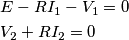
![\[\left\{\begin{matrix}
V1-3*I2-2=0& & \\
2*V2-I2-1=0& & \\
V1=E-R*I1& & \\
V2=-R*I2& &
\end{matrix}\right.\]](/forum/latexrender/pictures/7e755e9ca3ed7cd88776cc2802f75a5a.png "\[\left\{\begin{matrix}
V1-3*I2-2=0& & \\
2*V2-I2-1=0& & \\
V1=E-R*I1& & \\
V2=-R*I2& &
\end{matrix}\right.\]")


