Elettrotecnica e non solo (admin)
 Un gatto tra gli elettroni (IsidoroKZ)
 Esperienza e simulazioni (g.schgor)
 Moleskine di un idraulico (RenzoDF)
 Il Blog di ElectroYou (webmaster)
 Idee microcontrollate (TardoFreak)
 PICcoli grandi PICMicro (Paolino)
 Il blog elettrico di carloc (carloc)
 DirtEYblooog (dirtydeeds)
 Di tutto... un po' (jordan20)
 AK47 (lillo)
 Esperienze elettroniche (marco438)
 Telecomunicazioni musicali (clavicordo)
 Automazione ed Elettronica (gustavo)
 Direttive per la sicurezza (ErnestoCappelletti)
 EYnfo dall'Alaska (mir)
 Apriamo il quadro! (attilio)
 H7-25 (asdf)
 Passione Elettrica (massimob)
 Elettroni a spasso (guidob)
 Bloguerra (guerra)


 Phoedus, non vorrei fare l'avvocato del diavolo, ma nel link che hai postato (http://faq.solarbotics.net/oscillate.html) c'è spiegato in modo dettagliatissimo (anche con un esempio che sfrutta l'acqua invece dell'energia elettrica) come funziona la cosa (il disegnino con l'imbuto sulla destra non è un allegro ornamento della pagina, ma la spiegazione pratica del principio di funzionamento, alla sua sinistra ci sono tutte le indicazioni step by step)
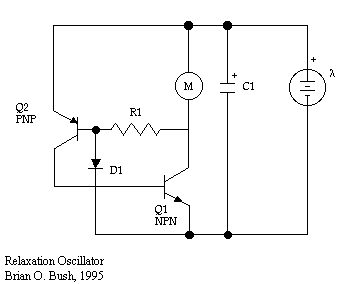
Lo schemino elettrico che risolve il problema è quello presente nel tuo link e che ho già postato (e ripeto qui per facilità di consultazione)
Il suo funzionamento è spiegato passo passo, punto per punto con molta chiarezza proprio nel link che hai postato tu (basta leggere)
Theory of Operation
Essentially the SE is a modified SCR (Silicon Controlled Rectifier) with supercritical feedback. I would like to point out that we are interested in the electron current, as opposed to conventional current (that is, the movement of positive charges, opposite to electron current), unless otherwise stated as so.
The following timeline are the events and circuit characteristics while charging and discharging:
EVENT - Beginning of charging cycle
Capacitor C1 begins to charge due to current from the solar cell and the voltage across C1 rises
Q2e is positive, which is required for conduction. However, the base, Q2b is also positive - from the resistor through the motor. Thus, current cannot flow from Q2c to Q2e.
In order for current to flow through Q1 (Q1e to Q1c), Q1b must be positive and Q1c must be negative. Otherwise, the collector-base [ N | P ] junction is basically a diode being reverse-biased. When there is no voltage connected to the base of an NPN then Q1 is equivalent to two diodes connected back-to-back, which do not conduct. (is this correct?)
Once the voltage of C1 reaches the trigger voltage of D1, which is forward biased, current flows through D1. (why at that trigger voltage?)
The current flowing through D1 establishes a source current from Q2b to Q2e. This in turn causes a greater current to flow from collector (Q2c) to the emitter (Q2e), thus allowing Q1b to see positive.
The current flowing from the Q2c to Q2e, causes a similar flow of current in Q1 from Q1e to Q1b, since Q1b is now positive.
(Recall, that if a small voltage is applied to the base -- enough to remove the depletion layer in the emitter-base junction, current flows from emitter to base as in a diode)
This small amount of current through Q1e to Q1b induces a larger flow of current from the emitter (Q1e) to the collector (Q1c).
The current flowing from Q1e to Q1c goes throgh motor, M, causing it to go spin.
EVENT - SE triggered, Beginning of discharging cycle
EVENT - Motor turns on
While the current is flowing through M, the voltage across C1 falls
EVENT - voltage across C1 falls below trigger point of D1
The base of Q2, Q2b is being feed current by way of D1 and also by way of R1. Thus, when the voltage falls below D1's trigger point, D1 stops conducting and current continues to flow into Q2b (and through to Q2e) by way of R1. Thus keeps Q2 on, which in turn keeps Q1 on, which allows the motor to run. And so on, until the motor resistance / load creates a high resistance whereby it essentially halts the cycle.
Here you will recognize that this behavior is very much like that of a Silicon Controlled Rectifier (SCR), in that load is turn ON by one method and OFF by another. With an SE, it is initially turned ON by the trigger, D1; and turned OFF when the motor's inertia and resistance is too large.
(note: Q1 is the main driving transistor switch that allows the current from C1 to flow through the motor M. Q1 can be doubled (see Darlington amplifier on p. 234 of gold electronics book) or replaced with higher current transistors - like the 2N2222.)
non sarebbe forse il caso che, vista l'esaurientissima spiegazione del perché e percome, tu ti studiassi bene quelle indicazioni e chiedessi chiarimenti riguardo ciò che ti dovesse essere poco chiaro ?
In tal modo almeno capiresti nel dettaglio la soluzione già presente senza perderti nel mare delle possibili variazioni sul tema
O meglio, se le vuoi affrontare tutte le possibili soluzioni bene, ma, ripeto, prima non sarebbe meglio che tu approfondisca e capisca bene come funziona il circuito di base ?
Quando si guida l'auto si parte in prima e poi si ingranano la seconda e quindi la terza, non viceversa, non ne convieni ?

K
p.s.: Per la questione dello zener (che in realtà negli schemi non c'è), ti consiglio di cercare con google le tabelle riassuntive dei componenti elettronici, così da impratichirti ed evitare fraintendimenti