Cos'è ElectroYou | Login Iscriviti

ElectroYou - la comunità dei professionisti del mondo elettrico

Reti RC "amplificatrici"

Problemi curiosi e quiz vari.

Moderatore: Foto Utentecarlomariamanenti

4
voti

[51] Re: Reti RC "amplificatrici"

Messaggioda Foto UtenteRenzoDF » 7 dic 2010, 15:32

DirtyDeeds ha scritto: Vuoi la verità? Ho scoperto l'esistenza dell'EET su questo forum, prima non ne avevo mai sentito parlare!

non sentirti in colpa, in Italia e non solo, non se ne parla proprio, solo qui a Santa Barbara sentiamo l'influenza del Caltech di Pasadena :D

DirtyDeeds ha scritto:... mi hanno fatto odiare l'elettrotecnica e la teoria delle reti, e per anni non ho più aperto un libro che ne parlasse). Per recuperare, ho aggiunto il Vorperian alla mia collezione di libri...

per fortuna che te l'hanno fatta odiare! ... chissa cosa succedeva se te l'avessero fatta amare :mrgreen:
Il Vorperian è il Testo di riferimento sull' EET e se lo sfogliavi ti saresti accorto che la rete l'avevo studiata proprio li :mrgreen:

Per esercizio, condenso il discorso sul metodo che ho imparato dal testo per ricavare la funzione di trasferimento: il denominatore attraverso un 3-EET e il numeratore con un loop jolly :D
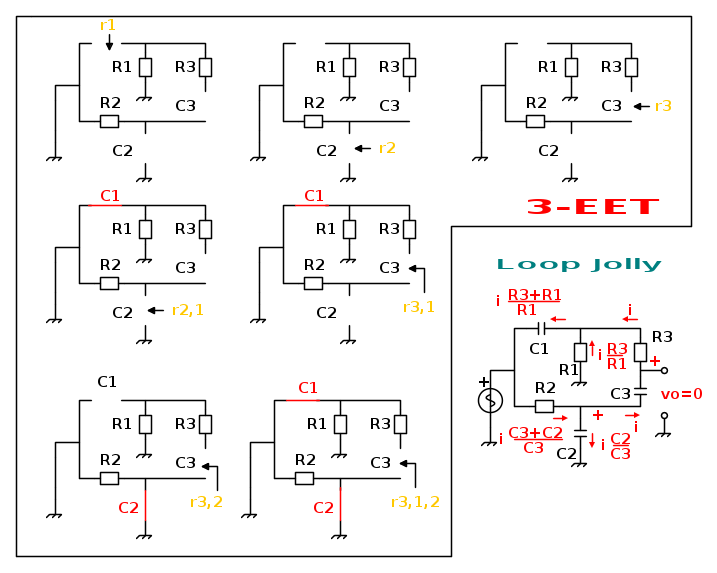

Per l'NEET quindi una semplice ispezione della rete porta alla determinazione del denominatore della TF mentre per gli zeri, oltre a quello nell'origine, ricaviamo il secondo da una semplice KVL :!:

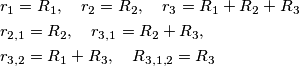
per le resistenze avremo

\begin{align}
  & r_{1}=R_{1},\quad r_{2}=R_{2},\quad r_{3}=R_{1}+R_{2}+R_{3} \\ 
 & r_{2,1}=R_{2},\quad r_{3,1}=R_{2}+R_{3}, \\ 
 & r_{3,2}=R_{1}+R_{3},\quad R_{3,1,2}=R_{3} \\ 
\end{align}

e dalla relazione generale valida per un 3-EET ohmico-capacitivo

D(s)=1+s\sum{r_{j}}C_{j}+s^{2}\sum{\sum{r_{i}C_{i}r_{i,j}C_{j}}}+s^{3}\sum{\sum{\sum{r_{i}C_{i}r_{i,j}C_{j}}}}r_{i,j,k}C_{k}

sostituendo otterremo

\begin{align}
  & D(s)=1+s[R_{1}C_{1}+R_{2}C_{2}+(R_{1}+R_{2}+R_{3})C_{3}]+s^{2}[R_{1}C_{1}(R_{2}C_{2}+(R_{2}+R_{3})C_{3})... \\ 
 & +R_{2}C_{2}(R_{1}+R_{3})C_{3}]+s^{3}R_{1}C_{1}R_{2}C_{2}R_{3}C_{3} \\ 
\end{align}

per il numeratore basterà scivere la KVL per la maglia C1-R3-C3-R2

i\left[ \frac{1}{sC_{1}}\frac{R_{3}+R_{1}}{R_{1}}+R_{3}+\frac{1}{sC_{3}}+R_{2}\frac{C_{3}+C_{2}}{C_{3}} \right]=0

che ci porta all'equazione caratteristica del secondo zero. Dal prodotto con lo zero nello zero avremo che il numeratore sarà

N(s)=s(R_{1}C_{1}+R_{2}C_{2}+R_{3}C_{3})+s^{2}(R_{1}C_{1}R_{2}C_{2}+R_{1}C_{1}R_{3}C_{3}+R_{1}C_{1}R_{2}C_{3})

e infine

H(s)=\frac{N(s)}{D(s)}
"Il circuito ha sempre ragione" (Luigi Malesani)
Avatar utente
Foto UtenteRenzoDF
55,9k 8 12 13
G.Master EY
G.Master EY
 
Messaggi: 13189
Iscritto il: 4 ott 2008, 9:55

2
voti

[52] Re: Reti RC "amplificatrici"

Messaggioda Foto Utentecarloc » 7 dic 2010, 15:48

@RenzoDF...

che poi sarebbe il buon vecchio Grabel?? Pensavo lo si studiasse solo a Pisa :mrgreen:
Se ti serve il valore di beta: hai sbagliato il progetto!
Avatar utente
Foto Utentecarloc
33,8k 6 11 13
G.Master EY
G.Master EY
 
Messaggi: 2153
Iscritto il: 7 set 2010, 19:23

2
voti

[53] Re: Reti RC "amplificatrici"

Messaggioda Foto UtenteDirtyDeeds » 7 dic 2010, 16:22

Ecco, il metodo di Grabel (all'epoca non sapevo che si chiamasse così), l'avevo incontrato per la prima volta,quando avevo 14-15 anni su un libro di scuola delle superiori, il Gasparini-Mirri, "Elettronica lineare e digitale", tant'è che l'ho usato in [33] per calcolarmi i coefficienti a_1 e a_2. In quel libro, il metodo veniva descritto solo per determinare il polo dominante e quello massimo. Allo stesso modo il metodo viene descritto nel Millman-Grabel e nel Gray-Meyer, e in quest'ultimo c'è anche un abbozzo di dimostrazione. Il primo libro in cui ho trovato una generalizzazione per il calcolo di tutti i coefficienti del denominatore di una funzione di trasferimento è il Feucht, che ho preso poco tempo fa, però mi sembra che neanche lì venga nominato l'EET.

Guardando i disegni che hai postato e leggendo i primi due capitoli del Vorperian mi sembra, in effetti, che i due metodi abbiano molto in comune, e che il Grabel sia solamente un sottocaso dell'N-EET. E' così?
It's a sin to write sin instead of \sin (Anonimo).
...'cos you know that cos ain't \cos, right?
You won't get a sexy tan if you write tan in lieu of \tan.
Take a log for a fireplace, but don't take log for \logarithm.
Avatar utente
Foto UtenteDirtyDeeds
55,9k 7 11 13
G.Master EY
G.Master EY
 
Messaggi: 7012
Iscritto il: 13 apr 2010, 16:13
Località: Somewhere in nowhere

2
voti

[54] Re: Reti RC "amplificatrici"

Messaggioda Foto Utentecarloc » 7 dic 2010, 17:52

il "Grabel" che conosco io è una regola che permette di calcolare i coefficienti del denominatore di qualsiasi funzione si possa scrivere per la rete (polinomio caratteristico). Si dimostra ricorsivamente ad esempio cosi`

Dove si tratta anche l'approsimazione quando un polo è dominante -che comunque è applicabile a qualsiasi polinomio ottenuto in qualsiasi modo, come dire non c'entra niente con Grabel-
Se ti serve il valore di beta: hai sbagliato il progetto!
Avatar utente
Foto Utentecarloc
33,8k 6 11 13
G.Master EY
G.Master EY
 
Messaggi: 2153
Iscritto il: 7 set 2010, 19:23

3
voti

[55] Re: Reti RC "amplificatrici"

Messaggioda Foto UtenteRenzoDF » 7 dic 2010, 18:14

DirtyDeeds ha scritto:Guardando i disegni che hai postato e leggendo i primi due capitoli del Vorperian mi sembra, in effetti, che i due metodi abbiano molto in comune, e che il Grabel sia solamente un sottocaso dell'N-EET. E' così?


non conosco il Grabel, ma penso proprio che l'Extra Element Theorem di Middlebrook pur partendo dalla relazione bilineare di Bode, vada ben oltre Grabel; l'NEET permette di ricalcolare tutta la funzione di trasferimento in presenza di N elementi addizionali :-)

Per un documento serio
"The N Extra Element Theorem" firmato da Middlebrook Vorperian & Lindar
http://ecee.colorado.edu/~ecen5807/course_material/papers/neet/neet-paper.pdf
Per un post applicativo di un 2-EET relativo al teorema di Miller
http://www.electroportal.net/phpBB2/vie ... ET#p158317
"Il circuito ha sempre ragione" (Luigi Malesani)
Avatar utente
Foto UtenteRenzoDF
55,9k 8 12 13
G.Master EY
G.Master EY
 
Messaggi: 13189
Iscritto il: 4 ott 2008, 9:55

1
voti

[56] Re: Reti RC "amplificatrici"

Messaggioda Foto Utentecarloc » 7 dic 2010, 18:17

mooooolto interessante :D ...me lo studio..
Se ti serve il valore di beta: hai sbagliato il progetto!
Avatar utente
Foto Utentecarloc
33,8k 6 11 13
G.Master EY
G.Master EY
 
Messaggi: 2153
Iscritto il: 7 set 2010, 19:23

4
voti

[57] Re: Reti RC "amplificatrici"

Messaggioda Foto Utentecarloc » 8 dic 2010, 12:17

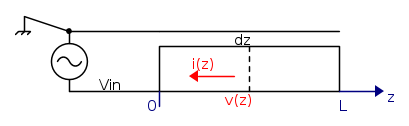
..avanzamento lavori per il circuito di DirtyDeeds...


direi che a regime sinosoudale si può scrivere trascurando gli infinitesimi di ordine superiore...
\frac{\partial v}{\partial z}=\mathcal{R}i

\frac{\partial i}{\partial z}=-j \omega \mathcal{C} v


che derivate ancora in z....con un po' di sostituzioni...e definendo \Omega=\mathcal{RC}\omega la pulsazione normalizzata

\frac{\partial ^2}{\partial z^2}v=\frac{\partial \mathcal{R}}{\partial z}i+\mathcal{R}\frac{\partial i}{\partial z}
=\frac{\partial \mathcal{R}}{\partial z}\frac{1}{\mathcal{R}}\frac{\partial v}{\partial z}+\mathcal{R}(-j\omega \mathcal{C}v)
=\frac{1}{\mathcal{R}}\frac{\partial \mathcal{R}}{\partial z}\frac{\partial v}{\partial z}-j\Omega v

\frac{\partial ^2}{\partial z^2}i=
-j\omega\left ( \frac{\partial \mathcal{C}}{\partial z}v+\mathcal{C}\frac{\partial v}{\partial z}\right)=
-j\omega\left(\frac{\partial \mathcal{C}}{\partial z}\;\frac{1}{-j\omega\mathcal{C}}\frac{\partial i}{\partial z}+\mathcal{CR}i\right)

la cosa somiglia molto (anzi è proprio) come l'analisi di una linea di trasmissione... il fatto che \mathcal{L} e \mathcal{G} siano zero non disturberebbe neanche, solo quella "geometria variabile"... :roll: :roll:
Comunque il buon DirtyDeeds ci ha voluto abbastanza bene perché....

\frac{1}{\mathcal{R}}\frac{\partial \mathcal{R}}{\partial z}=\frac{1}{\mathcal{R}_0e^{az}}a\mathcal{R}_0e^{az}=a

\frac{1}{\mathcal{C}}\frac{\partial \mathcal{C}}{\partial z}=\frac{1}{\mathcal{C}_0e^{-az}}(-a\mathcal{C}_0e^{-az})=-a

che sostituiti

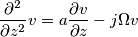
\frac{\partial^2}{\partial z^2}v=a\frac{\partial v}{\partial z}-j\Omega v

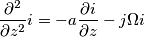
\frac{\partial^2}{\partial z^2}i=-a\frac{\partial i}{\partial z}-j\Omega i

le equazioni caratteristiche sono

\lambda^2-a\lambda+j\Omega=0
\lambda^2+a\lambda+j\Omega=0

che hanno lo stesso discriminante \Delta=\sqrt{a^2-4j\Omega}=\pm 2\gamma con \gamma(\Omega) \in \mathbb{C}

e allora avremo i "coefficienti di propagazione"
k_v^+=\frac{a}{2}+\gamma\;\;\;k_v^-=\frac{a}{2}-\gamma

k_i^+=-\frac{a}{2}+\gamma\;\;\;k_i^-=-\frac{a}{2}-\gamma

e la tensione e la corrente saranno
v(z)=V^+e^{k_v^+z}+V^-e^{k_v^-z}

i(z)=I^+e^{k_i^+z}+I^-e^{k_i^-z}

Resta "solo" il problema di Cauchy... ovviamente v(0)=V_{in} e i(L)=0 ma forse non bastano... magari c'è da definire l'impedenza Z(z) per "legare" le due quantità...comunque il fatto che i coefficienti non siano complessi coniugati è proprio "brutto" :(

per ora mi fermo qui :( attendo "mazzate" magari è solo una via di soluzione ad alta entropia :mrgreen:
Se ti serve il valore di beta: hai sbagliato il progetto!
Avatar utente
Foto Utentecarloc
33,8k 6 11 13
G.Master EY
G.Master EY
 
Messaggi: 2153
Iscritto il: 7 set 2010, 19:23

2
voti

[58] Re: Reti RC "amplificatrici"

Messaggioda Foto Utentecarloc » 8 dic 2010, 13:27

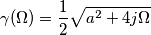
#-o #-o Edit: errore nel segno di \frac{\partial i}{\partial z} ... Seconda formula!! #-o #-o

ovviamente propagato fino alla fine...credo comunque cambi solo il discriminate delle eq. caratteristiche, ma niente nella sostanza come dire

\gamma(\Omega)=\frac{1}{2}\sqrt{a^2+4j\Omega}
Se ti serve il valore di beta: hai sbagliato il progetto!
Avatar utente
Foto Utentecarloc
33,8k 6 11 13
G.Master EY
G.Master EY
 
Messaggi: 2153
Iscritto il: 7 set 2010, 19:23

2
voti

[59] Re: Reti RC "amplificatrici"

Messaggioda Foto UtenteRenzoDF » 8 dic 2010, 16:05

DirtyDeeds ha scritto:Guardando i disegni che hai postato e leggendo i primi due capitoli del Vorperian mi sembra, in effetti, che i due metodi abbiano molto in comune, e che il Grabel sia solamente un sottocaso dell'N-EET. E' così?


Dopo aver recuperato il documento originale di Grabel e Cochrun grazie a Isidoro :D
"A method for the determination of the transfer function of electronic circuits" avrei voluto risponderti piu' estesamente, ma nella ricerca ho trovato una soluzione migliore, ovvero ti rispondo con una lettera autografa di Middlebrook sull'argomento

August 15, 2010
A letter from Dr. Middlebrook including his philosophy

In an earlier post I mentioned a letter Dr. Middlebrook had sent to me that touched on the N-Extra-Element Theorem, but also included what I thought was a nice summary of his philosophy. Here I include the entire letter:


June08, 1999
Dear Steve:

Thank you for your letter of May 28. I enjoyed doing the NEET
presentation, and Bob Gourlay sent me a nice note of appreciation.

I'm at our time share in Palm Springs this week, so I don't have
any references handy, either.

It is quite well known that the coefficient of the s term in a
denominator polynomial is the sum of the OCTCs, and everything Thompson
says about it, subject to the specified limitations, is correct. In a 1973
paper, Cochrun and Grabel extended the method to show how to calculate the
coefficients of the higher power s terms in the denominator polynomial.
This involves calculation of TCs with one or more of the capacitances short
instead of open, and is exactly equivalent to the NEET.

The NEET is the "ultimate" extension in two ways: first, it applies
not only to capacitances (or inductances) and their driving point
resistances, but to impedances and their driving point impedances (dpi's);
second, it applies to the numerator polynomial as well, in which the dpi's
are all null double injection calculations. It is a further and independent
step to find the poles and zeros as the roots of the two polynomials.

You bring up an interesting question as to why so much useful
information has been published, but has not been picked up. My course is
MOSTLY such things, and I discuss this question in Part 2. For example,
loop gain measurement by injection from a current probe used backwards was
published in an HP App Note in 1961. No-one noticed until I and then Dean
Venable started promoting it, and STILL it's almost unknown outside the
power supply community. I published the input/output impedance theorem in
1964, and the EET in 1988; both are still unknown to anyone who hasn't
heard me or my students talk about it.

Why doesn't any of this show up in textbooks? My GUESS is:
textbooks are written by professors, most of whom haven't worked in
industry. The reason they write their own book is that they have one or two
extensions or extra topics to promote, but the rest of the book still has
to cover the "required basics" which they essentially copy from all the
hundreds of existing textbooks. They have no motivation to incorporate
anything different or better that was done by other people.

A big reason why most of the good stuff out there doesn't get
picked up is that the authors do almost nothing to show why their method or
result is useful, or how to use it, and to start with their result is
obscured in abstruse math (high entropy expressions). No working design
engineer is going to bother reading an article that is littered with matrix
algebra! I have adopted as my "mission in life" the function of
INTERPRETER, to show how the academics stuff can actually be USED. That's
what my course (and book) are all about; it's why I call it "Technical
Therapy." I hope others will incorporate the philosophy into their OWN
textbooks.

The technical world needs many more interpreters to write articles
at all levels intermediate between the trade journals and the source
journals. Vatche wrote one in EDN about the EET, and is now working on a
whole book about "neat tricks", mostly involving the NEET. It was a stated
objective of my NEET paper not to exhibit a single matrix, but I'm afraid
it is still overwhelming to working engineers and Vatche's book will be
needed to bridge the gap.

It's interesting that Marc Thompson wrote the article in Electronic
Design because he had an industry deign specification to meet. He applied
the method he'd learned as an MIT student (Richard B. Adler is an MIT
professor), but apparently he doesn't know about Cochrun and Grabel
(although Grabel wrote a book!).

I don't know whether this topic qualifies as a "paradox", but if
you run out of strictly technical paradoxes at the June meeting, you might
want to throw this out for discussion.

Thanks for sending me the Thompson article. I hadn't seen it.

Sincerely// David Middlebrook

http://powerelectronicsgroup.posterous. ... ing-his-ph
"Il circuito ha sempre ragione" (Luigi Malesani)
Avatar utente
Foto UtenteRenzoDF
55,9k 8 12 13
G.Master EY
G.Master EY
 
Messaggi: 13189
Iscritto il: 4 ott 2008, 9:55

2
voti

[60] Re: Reti RC "amplificatrici"

Messaggioda Foto UtenteDirtyDeeds » 8 dic 2010, 16:44

Grazie, direi che questo risponde pienamente alla mia domanda :ok: E condivido pienamente le osservazioni di Middlebrook. Peccato che questa lettera sia stata scritta undici anni fa e che, a oggi, la situazione sia sempre quella :(
It's a sin to write sin instead of \sin (Anonimo).
...'cos you know that cos ain't \cos, right?
You won't get a sexy tan if you write tan in lieu of \tan.
Take a log for a fireplace, but don't take log for \logarithm.
Avatar utente
Foto UtenteDirtyDeeds
55,9k 7 11 13
G.Master EY
G.Master EY
 
Messaggi: 7012
Iscritto il: 13 apr 2010, 16:13
Località: Somewhere in nowhere

PrecedenteProssimo

Torna a Ah, ci sono!

Chi c’è in linea

Visitano il forum: Nessuno e 7 ospiti